Don’t Look Away
Every two days, a woman or girl is killed in Canada.
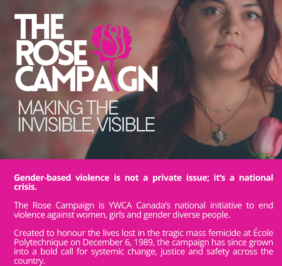
Gender-based violence is not a private issue; it’s a national crisis. Too often, it’s hidden, minimized or ignored. In every community across this country, roses are still being laid for lives lost to gender-based violence, even when we don’t see them.
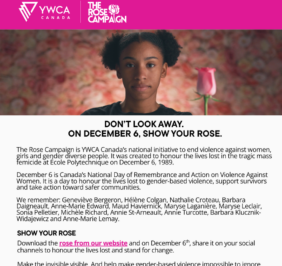
The Rose Campaign is YWCA Canada’s largest and longest-running national initiative, dedicated to ending violence against women, girls, and gender diverse people. It was created to honour the lives lost in the tragic mass femicide at École Polytechnique on December 6, 1989, and has since grown into a bold call for systemic change, justice and safety across the country.
Ending gender-based violence will take all of us. Every conversation, donation, shared story and act of advocacy can help make communities safer and support survivors.
Join us in making the invisible visible.
Because we can’t change what we refuse to see.
Help Make the Invisible, Visible
There is a gender-based violence epidemic in Canada.
Every two days, a woman or girl is killed. Every four days, that death is at the hands of a current or former intimate partner. Indigenous women, 2SLGBTQIA+ individuals, women with disabilities, and women living in poverty or rural areas face higher rates of violence.
This campaign is a national initiative to end gender-based violence. With it, we also remember and honour the 14 women murdered during the mass femicide at École Polytechnique on December 6, 1989, now recognized as Canada’s National Day of Remembrance and Action on Violence Against Women.

Why We
Must Act
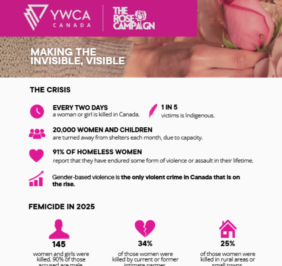
Every two days a woman or girl is killed in Canada. Every four days, it’s by a current or former intimate partner.
20,000 women and children are denied access to shelters each month.
91% of homeless women report that they have endured some form of violence or assault in their lifetime.
In 2025, 147 women and girls were killed.
Nearly half of women in relationships have experienced abuse, with many more never reporting it.
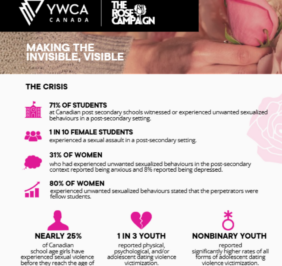
71% of students at Canadian post-secondary schools witnessed or experienced unwanted sexualized behaviours in a post-secondary setting.
1 in 10 female students have experienced a sexual assault in a post-secondary setting.
31% of women who have experienced unwanted sexualized behaviours in the post-secondary context reported being anxious and 8% reported being depressed.
80% of women who have experienced unwanted sexualized behaviours stated that the perpetrators were fellow students.
Nearly 25% of Canadian school age girls have experienced sexual violence before they reach the age of 16.
1 in 3 youth reported experiencing physical, psychological, and/or adolescent dating violence.
Nonbinary youth reported experiencing significantly higher rates of all forms of adolescent dating violence.
Begin Today.
Donate to YWCA Canada’s Rose Campaign.
Your generosity helps fund trauma-informed programs, advocacy, and support for survivors and their children. Donate here.
On December 6, Show Your Rose.
December 6 is Canada’s National Day of Remembrance and Action on Violence Against Women.
This December 6, let’s flood our feeds with roses. 🌹 Post a rose emoji. Share a digital rose or profile picture overlay. Wear your rose pin. Hold up a real rose.
However you show it, show your rose. Signal solidarity. Make the invisible visible. And help make gender-based violence impossible to ignore.
Organize Collective Action With Our Activation Kits.
Whether you want to spark conversations in the workplace, host an event, or amplify awareness online, we’ve made it easy with ready-to-use social media posts, fact sheets, and activities that support the Rose Campaign.
- 20,000 Steps for Change — A team-based walking challenge that raises awareness about gender-based violence in Canada. Every month, nearly 20,000 women and children are turned away from shelters due to lack of space. Teams commit to walking 20,000 steps individually or collectively. The activity is flexible and easy to adapt for in-person, hybrid of remote teams.
- 16 Roses of Activism — A challenge aligned with the UN’s 16 Days of Activism Against Gender-Based Violence. Teams or individuals send 16 digital roses with personalized messages to raise awareness and show solidarity. Flexible format for remote, hybrid, or in-person participation.
- Request one or both toolkits here.
Support The Rose Campaign
Donations to YWCA Canada help fund:
- National policy advocacy and outreach
- National research, education and awareness
- Expanding access to support services for survivors and their children
- Strengthening the national YWCA movement
This campaign supports YWCA Canada, the national office of the YWCA movement in Canada. If you’d like to contribute to the efforts of your local YWCA member association, please find your community YWCA here.
Rose Campaign Resources


Thank you to our generous campaign sponsors:
Major Sponsors:


Supporting Sponsors:

About YWCA Canada
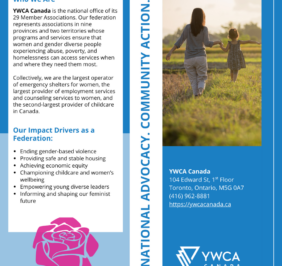
YWCA Canada is the country’s oldest and largest multiservice gender equity organization. A secular charity, we are dedicated to improving the lives of women, girls and gender diverse people. We work through community action and national advocacy, directly impacting the lives of more than 636,000 women, girls and gender diverse people each year. As part of a national and global movement, YWCAs across the country provide vital supports in gender-based violence prevention, housing, childcare and early learning, economic well-being, and youth engagement and leadership.
Sources:
Canadian Femicide Observatory for Justice and Accountability (CFOJA), Canadian Women’s Foundation (CWF), Women and Gender Equality Canada (WAGE), Alberta Council of Women’s Shelters (ACWS), National Resource Center on Domestic Violence (NRCDV), Homeless Hub, Fred Victor, Statistics Canada (2019), Anthistle, L. & Arella, S. (2024), Government of Nova Scotia, Bill 482 – Intimate Partner Violence Epidemic Declaration Act (September 2024), New Brunswick Women’s Council (2025), Building a Bigger Wave Network (2024), Robertson, K. (2023), Canadian Centre for Policy Alternatives, Government of Canada (2009), An Estimation of the Economic Impact of Spousal Violence in Canada, 2009, Women and Gender Equality Canada (2021), CARE (2018), The Cost of Violence Against Women and Girls, Canadian Women’s Foundation (2024), Community Foundations of Canada (2020), Paths Saskatchewan (2025), Femicide in Canada in 2024, Canadian Femicide Observatory for Justice and Accountability (2025).